<?xml version="1.0" encoding="utf-8"?>
<feed xmlns="http://www.w3.org/2005/Atom">
    <title>Pranshu's blog</title>
    <subtitle><![CDATA[Random posts]]></subtitle>
    <link href="https://puff-paddi.github.io/rss.xml" rel="self" />
    <link href="https://puff-paddi.github.io" />
    <id>https://puff-paddi.github.io/rss.xml</id>
    <author>
        <name>Pranshu Sharma</name>
        
        <email>pranshu@bauherren.ovh</email>
        
    </author>
    <updated>2026-04-14T00:00:00Z</updated>
    <entry>
    <title>Future of linux desktop</title>
    <link href="https://puff-paddi.github.io/posts/2026-future-of-linux-desktop.html" />
    <id>https://puff-paddi.github.io/posts/2026-future-of-linux-desktop.html</id>
    <published>2026-04-14T00:00:00Z</published>
    <updated>2026-04-14T00:00:00Z</updated>
    <summary type="html"><![CDATA[<article>
    <section class="header">
        Posted on April 14, 2026
        
    </section>
    <section class="info">
	
        tags: <a title="All pages tagged &#39;tech&#39;." href="/tags/tech.html" rel="tag">tech</a>
        
    </section>
    <section>
        <h1 id="intro">Intro</h1>
<p>At the start of this year, I installed Linux Mint on my main laptop. I’ve used Mint Mate edition before on my secondary laptop a bit, so I wasn’t new by then. Since then, because of various issues I’ve distrohopped</p>
<pre><code>Mint (lack of touchpad gestures + freezing thumbnails)
-&gt; Ubuntu (Anti snap propaganda got to my head)
-&gt; Fedora (Issue where &#39;output&#39; speakers list grew infinitly and crashed GNOME + headphone jack issue)
-&gt; opensuse tumbleweed (failing updates + bricked system + headphone jack issue)
-&gt; Ubuntu</code></pre>
<p>I’ve learned quite a lot from this journey, and now I’ve used being on ubuntu for about a month and I think I can confidently say that I will stay.</p>
<p>None of the distros I’ve used were bad, they just weren’t for me. The 2 most important features of any linux distros are frequncy of updates/stability and look and feel. All else is secondary. Fedora’s dnf might be better than ubuntu’s apt, but I like ubuntu’s take on GNOME more. Yes, I could make fedora like ubuntu, but the burden of maintaince would be on me.</p>
<h1 id="the-main-problem-with-desktop-linux">The main problem with desktop linux</h1>
<p>Sadly, there isn’t a single ‘main problem’, if there was it’d just be easy to fix it and enter the <em>year of the linux desktop</em>. Along with freedom, comes the freedom to mess up easily. What we strive for, is up to date packages and general system stability.</p>
<p>Every time you install a package using a traditional package manager(apt, dnf, pacman, etc…), then basiclly you run an install script the package provides, where they can pretty much do anything(yes, you could theoretically make a package that runs DOOM during installation). So basiclly you mutate your root directories to install a package. This is an extremely chaotic approach, and often the root cause for instability.</p>
<p>All we want is for distros to focus on the feel of the desktop, be unbreakable. This is incompatible with traditional package managers<a href="#fn1" class="footnote-ref" id="fnref1" role="doc-noteref"><sup>1</sup></a>.</p>
<p>The solution to this is actually quite simple, make every directory other than <code>/home</code> immutable. That way, you can rollback all upgrades, maintance is super easy as the devs know everyones file system is synced, and the system is more stable, as updates are applied as full images instead of constantly mutating the system.</p>
<h2 id="immutable-linux-distros-problems">Immutable linux distros: Problems</h2>
<p>Ok, so we now have immutable distros where only the <code>/home</code> directory is under the user’s control. There’s a very obvious problem with this: You can’t install packages, as they mutate the system. There are 2 solutions that most distros use:
1. Use flatpaks for gui apps.
2. For other packages, ‘layer’ them (tools like <code>rpm-ostree</code> do this). So say you ‘layer’ emacs on your immutable system, your system becomes <code>base + mutation(emacs)</code>. So whenever you update, your <code>base</code> syncs to the official base image, then is mutated with emacs. This can get really slow really fast once you have <code>base + mutation(a) + mutation(b) + mutation(c)</code>, where for every update base will be synced, then mutations <code>a</code>, <code>b</code>, and <code>c</code> will be applied.</p>
<p>Considering that now to install any cli program, any daemon, or anything that can’t come as a flatpak(you can use flatpaks to install cli programs, but it’s painful and it’s not what flatpak is designed for, you’ll have to do <code>flatpak run org.gnu.ls</code> if you wanted to run a fictional flatpak version of <code>ls</code>) you’ll need to take the latter approach for most things, now I bet immutable distros don’t seem so attractive anymore. Luckily, there’s a simple solution.</p>
<h1 id="snaps">Snaps</h1>
<p>BUT.. BUT… SNAPS BAD, SNAPS SLOW, NOT OPEN SOURCE, BAD DEPENDENCY MANAGEMENT , EVIL.</p>
<p>Let’s address this: Snaps are not slow anymore, they used to be, but that’s simply not a problem anymore. Snaps are open source, the only thing that isn’t is cannonical’s backend code for the snap <a href="#fn2" class="footnote-ref" id="fnref2" role="doc-noteref"><sup>2</sup></a>. Contrary to popular belief, snap do use shared dependencies, just not the traditional way. Most libraries are included in each snap, but snaps can reuse parts of other snaps.</p>
<p>Now, lets talk about why snaps are good:
- They are sandboxed, like flatpaks
- They are immutable
- ANY <code>.deb</code> or rpm package can be a snap. Even the linux kernal can be a snap(see ubuntu core).</p>
<h1 id="the-future">The future</h1>
<p>So why did I bring up snaps? Well, it’s obvious now, that they can replace the flatpak + layering combo for immutable distros. So you’ll be able to install everything(cli tools, gui stuff, daemons, etc…) with snaps and enjoy the unbreakable stability of an immutable distro at the same time. No more worrying about updates breaking things, or tiny user specific bugs.</p>
<p>Although a immutable snap based version of ubuntu dosn’t exist yet, it’s likley cannonical is going to come out with one, and when it does, I’m switching.</p>
<section id="footnotes" class="footnotes footnotes-end-of-document" role="doc-endnotes">
<hr />
<ol>
<li id="fn1"><p>There are distro’s that come close to this, for example opensuse tumbleweed which uses BTRFS to provide functionality. However, it’s still a hack, your system still mutates constantly. Recently, opensuse updated to systemd-boot from grub. You had to do this manually, as there was no image to sync to that would have done this for you. Users shouldn’t have to go through this.<a href="#fnref1" class="footnote-back" role="doc-backlink">↩︎</a></p></li>
<li id="fn2"><p>Although I don’t agree fully with this decison, you can see why they did this, they don’t want other people making snap stores so easily because you are basiclly giving anyone whose repo you install a snap from root access. It’s the same for flatpak, I bet you don’t have any non flathub flatpaks, why?<a href="#fnref2" class="footnote-back" role="doc-backlink">↩︎</a></p></li>
</ol>
</section>
    </section>
</article>
]]></summary>
</entry>
<entry>
    <title>I'm back</title>
    <link href="https://puff-paddi.github.io/posts/2025-newwebsite.html" />
    <id>https://puff-paddi.github.io/posts/2025-newwebsite.html</id>
    <published>2025-11-16T00:00:00Z</published>
    <updated>2025-11-16T00:00:00Z</updated>
    <summary type="html"><![CDATA[<article>
    <section class="header">
        Posted on November 16, 2025
        
    </section>
    <section class="info">
	
        tags: <a title="All pages tagged &#39;life&#39;." href="/tags/life.html" rel="tag">life</a>
        
    </section>
    <section>
        <h1 id="intro">Intro</h1>
<p>This is my first post in 6 month or so, and the reason is mostly
because I wasn’t satisfied with my <a href="2025-intro">past blogging setup</a>.
Now, I switched the website up completely, and it’s much better
right now<a href="#fn1" class="footnote-ref" id="fnref1" role="doc-noteref"><sup>1</sup></a>.</p>
<h1 id="futre">Futre</h1>
<p>I’ll be doing at the very minimum one article per month. I already
have the next 2 debunk ideas ready. I’m going to do an
anarcho-primitivism debunk, and then a debunk of common crypto
critisim debunks.</p>
<p>As for the direction of this blog, I’ll be activily trying not to make
this ‘just another tech blog’ that posts about stuff already written
about by 10+ people, so although I will still write tech articles,
they will be far from exclusive in this blog.</p>
<section id="footnotes" class="footnotes footnotes-end-of-document" role="doc-endnotes">
<hr />
<ol>
<li id="fn1"><p>I’ll write about the new setup in the near future<a href="#fnref1" class="footnote-back" role="doc-backlink">↩︎</a></p></li>
</ol>
</section>
    </section>
</article>
]]></summary>
</entry>
<entry>
    <title>Building this website (old)</title>
    <link href="https://puff-paddi.github.io/posts/2025-intro.html" />
    <id>https://puff-paddi.github.io/posts/2025-intro.html</id>
    <published>2025-04-05T00:00:00Z</published>
    <updated>2025-04-05T00:00:00Z</updated>
    <summary type="html"><![CDATA[<article>
    <section class="header">
        Posted on April  5, 2025
        
    </section>
    <section class="info">
	
        tags: <a title="All pages tagged &#39;tech&#39;." href="/tags/tech.html" rel="tag">tech</a>
        
    </section>
    <section>
        <h1 id="update">UPDATE!!!</h1>
<p><strong>November 2025:</strong>
Pretty much everything in this post is invalid as I use a completely
different system now.</p>
<h1 id="intro">Intro</h1>
<p>Right after spending about 2 weeks in making <em>genorg</em>, my supreme and
<em>functioning</em> (most of the time) static site generator<a href="#fn1" class="footnote-ref" id="fnref1" role="doc-noteref"><sup>1</sup></a>, here are the
hows and whys.</p>
<h1 id="criteria">Criteria</h1>
<blockquote>
<p>My criteria compared to your career just isn't fair</p>
</blockquote>
<ul>
<li>The <del>markup</del> document type for the a blog article should be
<a href="https://orgmode.org/">Org</a>, or something as powerful(void).</li>
<li>The org to html function should be complete and work well. Currently
(and eternally), this is only done by the emacs org exporter itself.</li>
<li>Categories</li>
<li>Moving files around in the 'articles' directory should still
produce the same output blog. This means that the category info
would need to be in the article file itself.</li>
<li>A powerful and flexible templating system. This would be used for
example to export to the blog page.</li>
<li>Rss feeds.</li>
</ul>
<h2 id="comparasion-of-other-static-site-generators">Comparasion of other static site generators</h2>
<p>Before I decided to make my own thing, I tried to find other static site
generator that would meet this criteria. At the end, I was left with 2
valid options.</p>
<h3 id="hugojekyll">Hugo/jekyll</h3>
<p>The compromise here would be using the shabby hugo org export, or use
Hugo. However, this could pretty much be fixed by using
<a href="http://ox-hugo.scripter.co">ox-hugo</a>. Now I look back at it, this would
probably have been the better choice. oh well, I'm happy with I have
now. I reccomend this to to all readers who have a similar criteria.</p>
<p>Plus, using Hugo would remind me too much of the
<a href="https://en.wikipedia.org/wiki/Hugo_(film)">film</a> with the same name
which I vaguely remember watching, hence forcing me to rewatch and waste
2 hours.</p>
<h3 id="org-publish">Org publish</h3>
<p>I couldn't move files, plus I would have to hand maintain the category
pages. No thanks, I got better things to do (<em>gulp</em>).</p>
<h1 id="the-solution">The solution</h1>
<p>Writing about programming instead of just programming kinda sucks, bear
with me.</p>
<h2 id="genorg"><code class="verbatim">genorg</code></h2>
<p><code class="verbatim">genorg</code> is a perl script which generates the sites from a
input directory and a TOML configuration file. It scours and converts a
bunch of org files in the directory, and converts them to html (if
needed). Each of these files contain a <em>id</em> for internal use, and a
<em>category</em>.</p>
<pre><code>  Input                  Cache                Output
+-----------+       +---------------+       +-----------+
| Org files | ----&gt; | direct org    | ----&gt; | Modified  |
|           | ----&gt; | html export   | ----&gt; | html      |
+-----------+       +---------------+       +-----------+
                       |        |
                    +---------------+       +-----------+
                    | Neccasary info| ----&gt; | navigtion |
                    | eg title, date| ----&gt; | files     |
                    +---------------+       +-----------+</code></pre>
<p>Of course, any good static site generator needs a good templating
system. So since <em>genorg</em> used perl, I had a obvious choice ahead:
<a href="https://template-toolkit.org/">Template::Toolkit</a>. Since it used C code
with perl bindings, it was extremly fast. But still very powerful since
it has been around for a while.</p>
<p>A example info file generated by genorg to communicate with genserve:</p>
<div class="sourceCode" id="cb2"><pre class="sourceCode json"><code class="sourceCode json"><span id="cb2-1"><a href="#cb2-1" aria-hidden="true" tabindex="-1"></a><span class="fu">{</span></span>
<span id="cb2-2"><a href="#cb2-2" aria-hidden="true" tabindex="-1"></a>  <span class="dt">&quot;landing&quot;</span><span class="fu">:</span> <span class="st">&quot;templates/index.html.tt&quot;</span><span class="fu">,</span></span>
<span id="cb2-3"><a href="#cb2-3" aria-hidden="true" tabindex="-1"></a>  <span class="dt">&quot;blog_dir&quot;</span><span class="fu">:</span> <span class="st">&quot;/blog/&quot;</span><span class="fu">,</span></span>
<span id="cb2-4"><a href="#cb2-4" aria-hidden="true" tabindex="-1"></a>  <span class="dt">&quot;rss_dir&quot;</span><span class="fu">:</span> <span class="st">&quot;/rss/:cat&quot;</span><span class="fu">,</span></span>
<span id="cb2-5"><a href="#cb2-5" aria-hidden="true" tabindex="-1"></a>  <span class="dt">&quot;main_rss&quot;</span><span class="fu">:</span> <span class="st">&quot;templates/main.xml&quot;</span><span class="fu">,</span></span>
<span id="cb2-6"><a href="#cb2-6" aria-hidden="true" tabindex="-1"></a>  <span class="dt">&quot;blog_file&quot;</span><span class="fu">:</span> <span class="st">&quot;templates/blog.html.tt&quot;</span><span class="fu">,</span></span>
<span id="cb2-7"><a href="#cb2-7" aria-hidden="true" tabindex="-1"></a>  <span class="dt">&quot;cpath&quot;</span><span class="fu">:</span> <span class="ot">[</span></span>
<span id="cb2-8"><a href="#cb2-8" aria-hidden="true" tabindex="-1"></a>    <span class="fu">{</span></span>
<span id="cb2-9"><a href="#cb2-9" aria-hidden="true" tabindex="-1"></a>      <span class="dt">&quot;file&quot;</span><span class="fu">:</span> <span class="st">&quot;templates/1.html&quot;</span><span class="fu">,</span></span>
<span id="cb2-10"><a href="#cb2-10" aria-hidden="true" tabindex="-1"></a>      <span class="dt">&quot;rss&quot;</span><span class="fu">:</span> <span class="st">&quot;templates/1.html.xml&quot;</span><span class="fu">,</span></span>
<span id="cb2-11"><a href="#cb2-11" aria-hidden="true" tabindex="-1"></a>      <span class="dt">&quot;cat&quot;</span><span class="fu">:</span> <span class="st">&quot;tech&quot;</span></span>
<span id="cb2-12"><a href="#cb2-12" aria-hidden="true" tabindex="-1"></a>    <span class="fu">}</span></span>
<span id="cb2-13"><a href="#cb2-13" aria-hidden="true" tabindex="-1"></a>  <span class="ot">]</span><span class="fu">,</span></span>
<span id="cb2-14"><a href="#cb2-14" aria-hidden="true" tabindex="-1"></a>  <span class="dt">&quot;files&quot;</span><span class="fu">:</span> <span class="ot">[</span></span>
<span id="cb2-15"><a href="#cb2-15" aria-hidden="true" tabindex="-1"></a>    <span class="fu">{</span></span>
<span id="cb2-16"><a href="#cb2-16" aria-hidden="true" tabindex="-1"></a>      <span class="dt">&quot;cat&quot;</span><span class="fu">:</span> <span class="st">&quot;tech&quot;</span><span class="fu">,</span></span>
<span id="cb2-17"><a href="#cb2-17" aria-hidden="true" tabindex="-1"></a>      <span class="dt">&quot;art&quot;</span><span class="fu">:</span> <span class="st">&quot;introblog&quot;</span><span class="fu">,</span></span>
<span id="cb2-18"><a href="#cb2-18" aria-hidden="true" tabindex="-1"></a>      <span class="dt">&quot;file&quot;</span><span class="fu">:</span> <span class="st">&quot;2025/intro.org.html&quot;</span></span>
<span id="cb2-19"><a href="#cb2-19" aria-hidden="true" tabindex="-1"></a>    <span class="fu">}</span><span class="ot">,</span></span>
<span id="cb2-20"><a href="#cb2-20" aria-hidden="true" tabindex="-1"></a>    <span class="fu">{</span></span>
<span id="cb2-21"><a href="#cb2-21" aria-hidden="true" tabindex="-1"></a>      <span class="dt">&quot;cat&quot;</span><span class="fu">:</span> <span class="st">&quot;tech&quot;</span><span class="fu">,</span></span>
<span id="cb2-22"><a href="#cb2-22" aria-hidden="true" tabindex="-1"></a>      <span class="dt">&quot;file&quot;</span><span class="fu">:</span> <span class="st">&quot;2025/window.org.html&quot;</span><span class="fu">,</span></span>
<span id="cb2-23"><a href="#cb2-23" aria-hidden="true" tabindex="-1"></a>      <span class="dt">&quot;art&quot;</span><span class="fu">:</span> <span class="st">&quot;new_window_cmds&quot;</span></span>
<span id="cb2-24"><a href="#cb2-24" aria-hidden="true" tabindex="-1"></a>    <span class="fu">}</span></span>
<span id="cb2-25"><a href="#cb2-25" aria-hidden="true" tabindex="-1"></a>  <span class="ot">]</span><span class="fu">,</span></span>
<span id="cb2-26"><a href="#cb2-26" aria-hidden="true" tabindex="-1"></a>  <span class="dt">&quot;main_rss_url&quot;</span><span class="fu">:</span> <span class="st">&quot;/rss&quot;</span></span>
<span id="cb2-27"><a href="#cb2-27" aria-hidden="true" tabindex="-1"></a><span class="fu">}</span></span></code></pre></div>
<p>The navigation files are considered stuff like the category pages. To
keep the urls the same even when a org file is moved, the site needs to
dynamically resolve links into respsecite file paths.
<code>example.com/category/article-id</code> needs to find the file and serve it.</p>
<h3 id="why-perl">Why perl?</h3>
<blockquote>
<p>Lisp has all the visual appeal of oatmeal with fingernail clippings
mixed in.</p>
</blockquote>
<p>Larry Wall, as always, puts it very well. The other reasons are because
of <a href="https://en.wiktionary.org/wiki/TMTOWTDI#English">TIMTOWDI</a>, and
typed containers (in combination with a weakly typed language.).</p>
<h2 id="genserve"><code class="verbatim">genserve</code></h2>
<p>So now to serve the dynamicly serve the genorg output, all we have to do
is parse the json file and redirect files accordingly. Easy enough…
right?</p>
<p>Well, it would be if I was satisfied with http requests taking 0.0001
seconds to be proccesed by genorg instead of 0.00001 seconds.</p>
<p>So I initally decided to make the http server part in Go. This did not
go well, I didn't like the language, I didn't like the http server the
standard library provided. So in about one day, I wrote <strong>300+ lines</strong>
of zig code to make it work.</p>
<p>Although the process was tedious, the result was worth it, as any
visitors get to save approximately <span class="math inline">10 × 10<sup>−</sup>5 <em>s</em><em>e</em><em>c</em><em>o</em><em>n</em><em>d</em><em>s</em></span> for every
visit.</p>
<h1 id="code">Code</h1>
<p>My beautiful code can be found <a href="file:///g:/asset/genorg">here</a>. As for
the http server code, I won't share that. Simply cause it's crappy
code and it's going to be easy to find exploits in it. If you do decide
to use <code class="verbatim">genorg</code>, I suggest using a fastcgi script to serve
content based of the parsed <code class="verbatim">json</code>.</p>
<h1 id="what-now">What now?</h1>
<p>I'm very happy with the software used to generate the blog and
articles, but I still want to add some HTML and CSS and images in the
home page and category pages to make the site more vibrant (I've
recived feedback that this site reminds a viewer of a 'bee'). Maybe
later, I'll write about the non-technical aspect of blogs and why I
wanted to have one.</p>
<h1 id="footnotes">Footnotes</h1>
<section id="footnotes" class="footnotes footnotes-end-of-document" role="doc-endnotes">
<hr />
<ol>
<li id="fn1"><p>Well, technically <em>genorg</em> does also have a dynamic part to it.<a href="#fnref1" class="footnote-back" role="doc-backlink">↩︎</a></p></li>
</ol>
</section>
    </section>
</article>
]]></summary>
</entry>
<entry>
    <title>New window commands for emacs</title>
    <link href="https://puff-paddi.github.io/posts/2025-window.html" />
    <id>https://puff-paddi.github.io/posts/2025-window.html</id>
    <published>2025-03-29T00:00:00Z</published>
    <updated>2025-03-29T00:00:00Z</updated>
    <summary type="html"><![CDATA[<article>
    <section class="header">
        Posted on March 29, 2025
        
    </section>
    <section class="info">
	
        tags: <a title="All pages tagged &#39;tech&#39;." href="/tags/tech.html" rel="tag">tech</a>
        
    </section>
    <section>
        <h1 id="intro">Intro</h1>
<p>Around September 2024, I also discovered this useful package for emacs
windows management
<a href="https://www.emacswiki.org/emacs/TransposeFrame">transpose-frame.el</a>.</p>
<p>Around this time, I read Tobias' article on <a href="https://blogs.gnome.org/tbernard/2020/01/17/doing-things-that-scale/">doing things that scale</a><a href="#fn1" class="footnote-ref" id="fnref1" role="doc-noteref"><sup>1</sup></a>.</p>
<p>So of course, as a changed man, I sent a simple email asking for
<code class="verbatim">tranpose-frame.el</code> to be moved to emacs core. But as it
turned out, the package had many things wrong at it's core which would
be impossible to fix without a rewrite.</p>
<p>Basiclly, <code class="verbatim">transpose-frame.el</code> relies on "copy pasting"
window states(like the buffer, overlays, etc…), which was a faulty
approach<a href="#fn2" class="footnote-ref" id="fnref2" role="doc-noteref"><sup>2</sup></a>. The correct approach required new code in emacs <em>C-land</em>
to be able to 'necromance' window objects when using the function
<code class="verbatim">split-window</code>. For this reason, simply changing up the code
in <code class="verbatim">transpose-frame.el</code> would not be sufficant. A full
rewrite was required.</p>
<p>So, not knowing how much work was in, I agreed to do it. So after
about 4 months of infrequent, <em>painful</em> work<a href="#fn3" class="footnote-ref" id="fnref3" role="doc-noteref"><sup>3</sup></a>, including constant
collaboration with Martin Rudalics, the <code class="verbatim">windows.c</code> and
<code class="verbatim">windows.el</code> maintainer who take care of all the code in
the <em>C-land</em> size. <strong>Now</strong>, emacs 31 has all the functionality that
<code class="verbatim">transpose-frame.el</code> had, plus extra. The file containg all
these comands is <code class="verbatim">window-x.el</code>, which <strong>can be found
here</strong>:
<a href="https://github.com/emacs-mirror/emacs/blob/master/lisp/window-x.el" class="uri">https://github.com/emacs-mirror/emacs/blob/master/lisp/window-x.el</a>.</p>
<h1 id="commands">Commands</h1>
<p>Now, I used a simple layout for the following images simply cause I was
too lazy to make more complex ones. Keep in mind, that these commands
can work for <strong>any</strong> complex window layout you can cook up.</p>
<p>I would suggest trying them and playing around with them, but if you
don't have emacs 31, this is a preview.</p>
<h2 id="transpose">Transpose</h2>
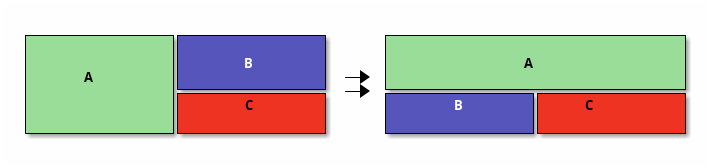
<p><code class="verbatim">M-x transpose-window-layout</code></p>
<p>This one is basiclly diagonal reflection.</p>
<p><img src="/2025stuff/window/transpose.png" /></p>
<h2 id="rotate-layout">Rotate layout</h2>
<p><code class="verbatim">M-x rotate-window-layout-clockwise</code></p>
<p><code class="verbatim">M-x rotate-window-layout-anticlockwise</code></p>
<p><img src="/2025stuff/window/rotate-clock.png" /></p>
<h2 id="flip">Flip</h2>
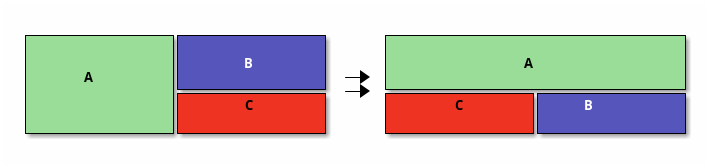
<p><code class="verbatim">M-x flip-window-layout-horizontally</code></p>
<p><code class="verbatim">M-x flip-window-layout-vertically</code></p>
<p><img src="/2025stuff/window/flip-v.png" /></p>
<h2 id="cycle-rotate-windows">Cycle (rotate windows)</h2>
<p>This one is my personal favourite.</p>
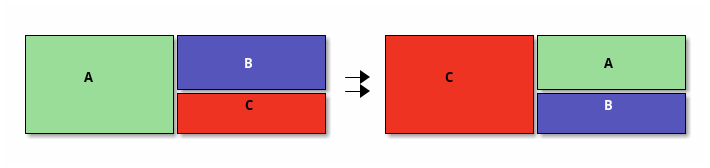
<p><code class="verbatim">M-x rotate-windows</code></p>
<p><img src="/2025stuff/window/cycle.png" /></p>
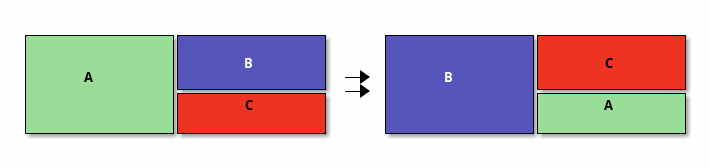
<p><code class="verbatim">M-x rotate-windows-back</code></p>
<p><img src="/2025stuff/window/cycle-anti.png" /></p>
<h1 id="footnotes">Footnotes</h1>
<section id="footnotes" class="footnotes footnotes-end-of-document" role="doc-endnotes">
<hr />
<ol>
<li id="fn1"><p>TLDR: instead of customizing and maintaing customizations, try push
changes to upstream<a href="#fnref1" class="footnote-back" role="doc-backlink">↩︎</a></p></li>
<li id="fn2"><p>This <a href="https://yhetil.org/emacs-devel/ac1735fd-e023-4e01-a3e2-2bd19087594c@gmx.at/">mail</a> goes in more detail about what was wrong with
<code class="verbatim">transpose-frame.el</code><a href="#fnref2" class="footnote-back" role="doc-backlink">↩︎</a></p></li>
<li id="fn3"><p>(The emacs window
system is much\, much\, more complex than what meets the surface)<a href="#fnref3" class="footnote-back" role="doc-backlink">↩︎</a></p></li>
</ol>
</section>
    </section>
</article>
]]></summary>
</entry>

</feed>